

Old Main stands on the edge of campus, its front doors facing N 9th Street. Despite no longer being the center of campus, Old Main is routinely passed by students, teachers, and faculty. Close to bus stops and mapped by countless sidewalks, people surround Old Main at almost all parts of the working day, walking to and from classes or heading inside the building to administrative meetings. The building is surrounded by large trees that reach past the roof and are home to countless birds. To the left of Old Main is the Classroom Building, the William's Conservatory, and the Biological Sciences building. Pride and the inspiration of education fills those who pass by or who are simply there to see the numbers of students walking towards new learning. Old Main, being the first building built for the University of Wyoming, represents the strive for education and life long learning.
A STORY FROM THE PERSPECTIVE OF OLD MAIN'S TOWER
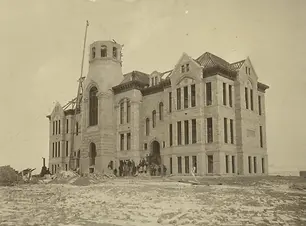
I stand tall above Old Main, gazing out to the plains. August comes fast, a whirlwind of faces new and old. I see the railroad tracks, the mechanical churn of the train bringing new students to our town. It's 1914 and a new school year is beginning. Students meet at Old Main and gaze up at me. The spirit of learning fills their eyes as I gaze back. They gather here for classes, listening with curious ears to their professor who shares expert knowledge. Laboratories and engineering classrooms fill the space of Old Main, welcoming those with the knack for it. The gym attracts students too, those who might need a break from learning. And for those who heed the call of brightening their mind, the library waits for them. For those who sing a soft tune or play strings so beautifully strung, there's a place for you too. Winter comes, 1915 approaches fast. Snow falls in a heavy blanket. I see students gathering outfront, organizing snowball fights or laying down to make snow angels. They may even hope that their classes get cancelled. Professors laugh as their students play; once again like children, perhaps that spark never dies. I feel the wind against me, maybe spring is coming. The snow melts but with it I begin to lean. And to crack. It's April and I hear them talking about me, about taking me down. Who will watch over them, the young minds of our school? Who will wait for that train and its mechanical churn? For Old Main and I, we are the center of it all, the meeting place, the glue some might say, of the University of Wyoming itself.
Written by Nora Dickerson
What is Public Memory?
Public memory is the process in which a community or society of people, big or small, collectively remembers some past history, monument, or story. Public memory not only offers physical sites of remembrance but also abstract ideas through different perspectives and interpretations of the site itself. In Roger C. Aden's article titled, "Public Memory", he writes about how places of public memory take on abstract forms as they "attempt to symbolize rather than represents an understanding of history." As a public memory site attempts to symbolize history, there is going to be more interpretations generated.
Source: "Public Memory" by Roger C. Aden In: The SAGE Encyclopedia of Communication Research Methods, 2019
Above Image: Taken from the American Heritage Center website

MEMORY SITES AND NOSTALGIA
Reflective nostalgia is concerned with reflecting on history or the past without wanting to specifically restore it as it was. Reflective nostalgia is seen through peoples' reactions after the tower was taken down people were upset and emotional but no one tried to reconstruct the tower itself. People have become comfortable exploring their own personal connections to the tower and how it made them feel both in the past, as it was still apart of Old Main, and in the now, as people reflect on the tower as it once was.
Source: "Nostalgia and Its Discontents'"
by: Svetlana Boym- The Hedgehog Review / Summer 07
Photo from The American Heritage Center
FORGETTING THAT IS CONSTITUTIVE IN THE FORMATION OF A NEW IDENTITY
There is a type of forgetting that involves the idea that things that are allowed to be forgotten provide living space for new projects; to create a new identity. While the Old Main tower was taken down for structural reasons, the students of the University work to forget about the tower to make room for the new identity of Old Main. Shortly after 1916, when the tower was taken down, students still remembered the tower, it was apart of living memory. Without the tower actively apart of the building, there becomes this gap in the identity of Old Main; without the tower, Old Main takes on a new identity of change. Of actively processing a new and shared identity in this new setting. It can represent an identity of newness and modern change.
Source: "Seven Types of Forgetting" by Paul Connerton, University of Cambridge / Memory Studies
Photo from the American Heritage Center